Classification Is a Snapshot
A classification according to ISO 14644-1 documents the state of a cleanroom at a particular moment. It says nothing about its state the following day. ISO 14644-2 closes exactly this gap: it governs how to demonstrate that a once-qualified cleanroom sustains its performance – and with the 2015 edition it evolved from a pure test calendar into a monitoring strategy.
The Monitoring Plan at the Heart of the Standard
The monitoring plan is central. It is derived from a risk assessment and defines where measurements are taken, how often, with which alert and action levels, how an excursion is responded to, and when the plan itself is to be reviewed. The standard therefore prescribes no template but requires a reasoned decision: sampling locations at the critical points of the process rather than evenly distributed across the floor area, and frequencies that match the risk of the respective area.
Maximum Intervals for Demonstrating Continued Compliance
The standard names maximum intervals that, as a rule, must not be exceeded:
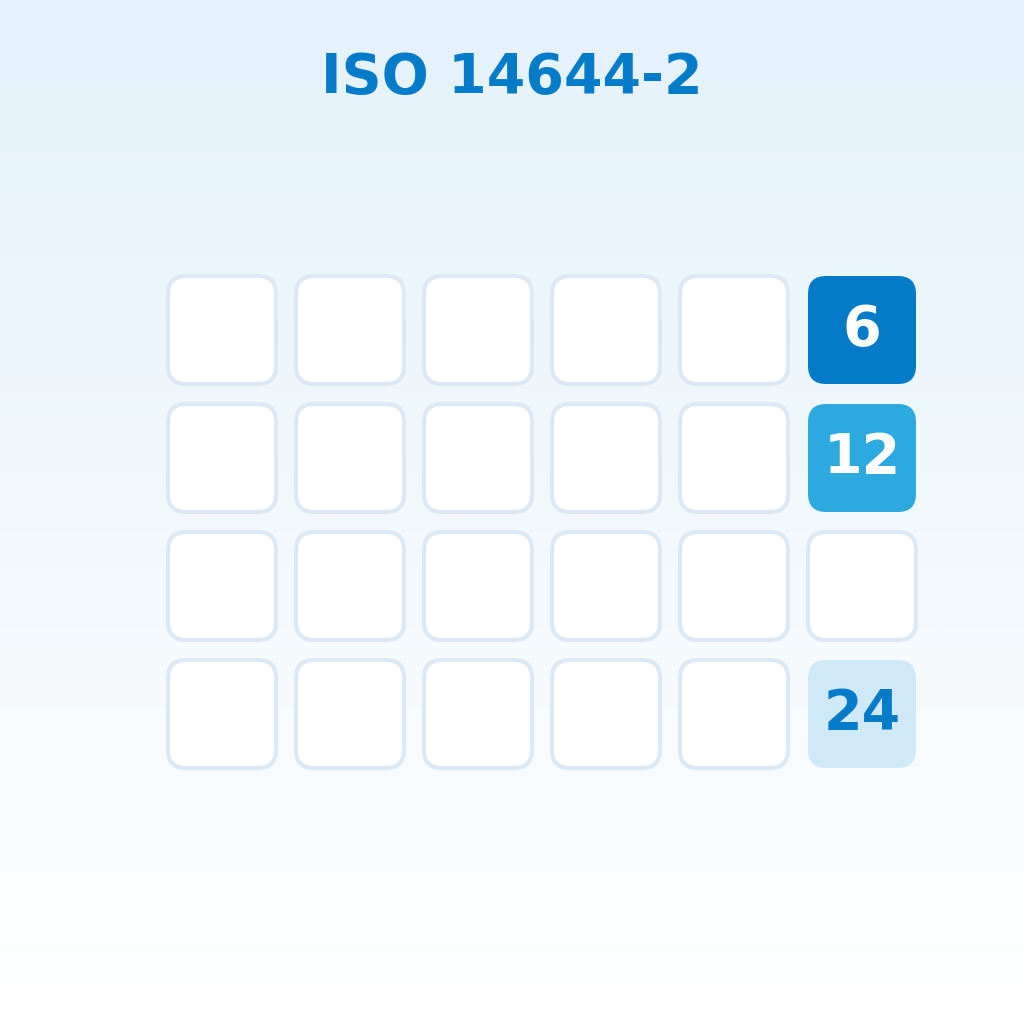
- Classification of particle concentration: every 6 months for ISO Class 5 and cleaner, every 12 months above ISO Class 5.
- Air pressure difference: every 12 months – the evidence for the pressure cascade between areas.
- Airflow volume or velocity: every 12 months, depending on the airflow regime of the area.
- Additional tests: installed filter system leakage, airflow visualisation, recovery and containment leakage are optional under ISO 14644-2 and, where scheduled, are performed at intervals of up to 24 months.
These intervals are the rule, not a rigid ceiling: ISO 14644-1:2015 explicitly permits in 5.1 that the intervals between classifications be extended where the installation is equipped for continuous or frequent monitoring and the monitoring results remain within the specified limits. ISO 14644-3:2019 points in the same direction: the risk assessment establishes the intervals, and monitoring data, trends and test results serve to confirm or adjust them. An extension is therefore possible – but only with a justification and a sound basis of data.
Different Deadlines Apply Under GMP
For sterile manufacturing the ISO intervals are not the governing benchmark. EU GMP Annex 1 states its own maximum requalification intervals in 4.32, graded by GMP grade rather than by ISO class: six months for Grade A and B, twelve months for Grade C and D – each referring to a defined test package comprising classification, filter integrity, air volume flow, pressure difference and air velocity. Requalification is additionally required after remedial action and after relevant changes. Two tests that ISO 14644-2 treats as supplementary are mandatory here: the integrity test of the final filters is a compulsory part of requalification – VDI 2083 Part 2 recommends it for every HEPA filter from H13 upwards on a twelve-month cycle – and where the airflow is not unidirectional, the recovery test takes the place of the air velocity measurement.
Discontinuous Does Not Mean Patchy – in Grade C and D
A widespread misconception holds that defensible evidence can only be produced with permanently installed instrumentation. Within the scope of ISO 14644-2 and, under GMP, for Grade C and D, that is not the case: Annex 1 requires there in 9.12 a monitoring regime based on qualification and routine data that enables effective trend analysis, without prescribing continuous acquisition. What matters is that the monitoring plan is justified, fully implemented and documented without gaps. Mobile, recurring measurements satisfy this requirement – provided that schedule adherence, sampling location assignment, limit evaluation and trending are demonstrably traceable. In practice it is not the measurements that fail here, but the documentation.
For Grade A and B this expressly does not apply. Annex 1 requires particle monitoring for the full duration of critical processing, including equipment set-up (9.16), and continuous monitoring of the Grade A zone for ≥ 0.5 µm and ≥ 5 µm at a minimum of 28 l/min, so that all interventions, transient events and any system deterioration are captured, with an alarm when the alert limit is exceeded (9.17). For Grade B a comparable system is recommended, with a possibly reduced sampling frequency (9.18), and Grade A additionally requires continuous microbiological air monitoring for the full duration of critical processing (9.24). Discontinuous measurements do not replace this.
Where Moqlero Comes In
Moqlero maps the monitoring plan as a workflow: measuring points, responsibilities, dates and repeats are held in the system instead of a spreadsheet. Evaluation against the limits happens automatically during the measurement, the signed report is generated immediately afterwards, and the trend types deliver the periodic assessment additionally required by EU GMP Annex 1. For the continuous monitoring of Grade A and B, Moqlero does not take the place of the permanently installed systems; it covers the recurring qualification and requalification tests. What has to be shown during an inspection does not have to be collected – it can simply be retrieved.
A monitoring plan is only as good as the evidence that it was actually followed!