Classification Starts with the Definition, Not with the Measurement
Long before the first value is recorded, the decisive choices have already been made: how many sampling locations there are, where they lie, how long each one is sampled and which particle sizes are considered at all. ISO 14644-1 governs precisely this – and anyone who only recalculates these points during evaluation puts the whole classification at risk.
The Four Definitions per Classification
Four points have to be determined and documented for every classification:
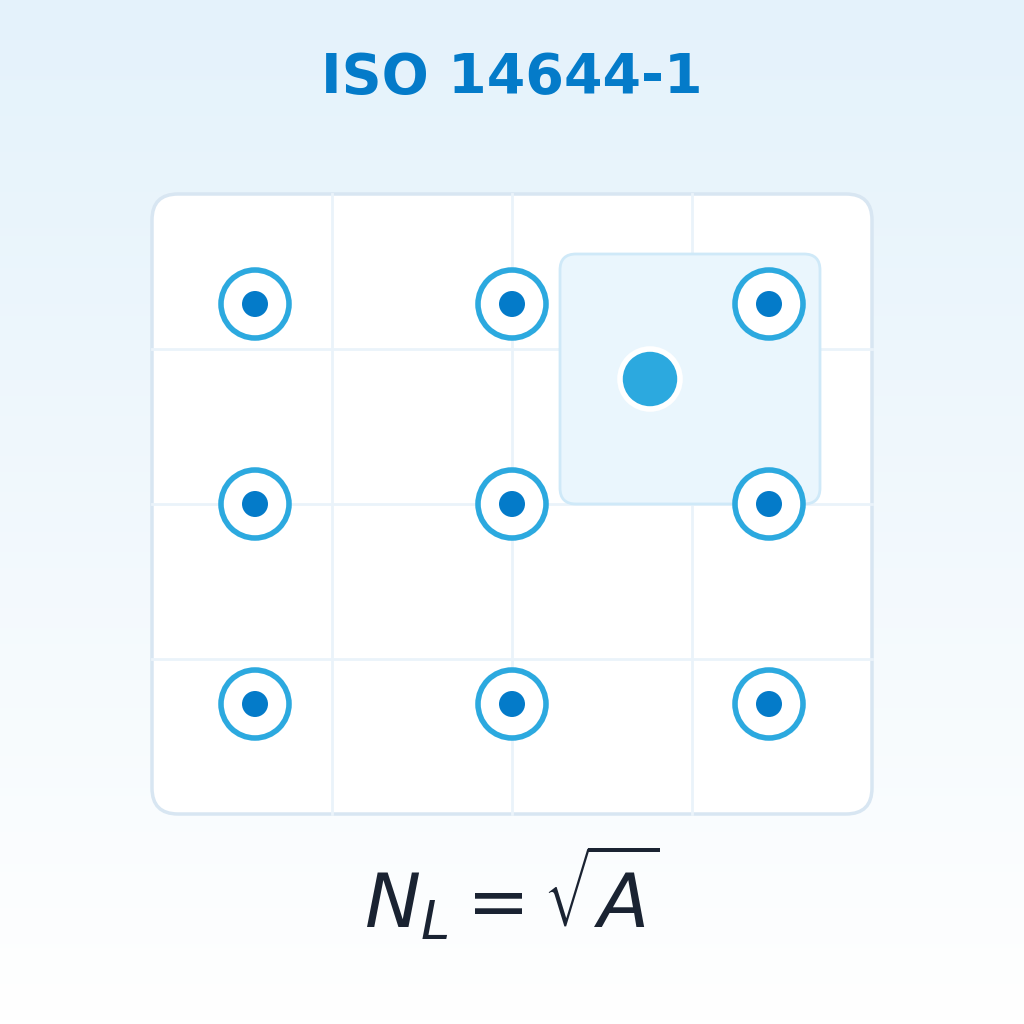
- Number of sampling locations: It follows from the cleanroom area via Table A.1 of the standard – 25 m² require seven locations, 64 m² twelve, 100 m² sixteen. The standard gives a formula only for areas above 1 000 m²: NL = 27 × √(A / 1 000), rounded up to the next whole number. The room is divided into that same number of equally sized sections; for each section, a location representative of it is selected. Critical zones may additionally be sampled as agreed. The occasionally quoted formula √(10 × A) does not belong here: it comes from ISO 14644-3, Annex B, and applies to the measuring grid for air velocity.
- Minimum sample volume: Each location must be sampled with enough air that, at a concentration equal to the class limit, at least 20 particles of the largest considered size would be counted – but at least 2 litres, with a sampling time of at least one minute.
- Considered particle sizes: A classification applies exclusively to the sizes actually considered. Which ones these are is part of the definition and belongs in the documentation – not every size can be meaningfully evaluated in every class. Where several sizes are considered, they must differ by at least a factor of 1.5 in accordance with 4.4: 0.3 µm and 0.5 µm are permissible, 0.4 µm and 0.5 µm are not.
- Occupancy state: The classification applies to a defined state: as built, at rest or in operation. A class designation without the corresponding state is worthless.
All of these requirements are minimums. The number of sampling locations derived from the area and the calculated sample volume must never be undercut, but may be exceeded at any time: additional sampling locations, longer sampling times, or larger volumes comply with the standard and are not a deviation – they increase the informative value of the classification. Only the reverse is inadmissible, i.e. fewer samples or smaller volumes than the standard requires.
What the 2015 Edition Removed
The 2015 revision removed the 95 % upper confidence limit that had to be calculated in addition for fewer than ten sampling locations. The annex to the revision states that this limit was neither appropriate nor consistently applied in 1999, and it discards the underlying assumption of a normal distribution. It was replaced by a statistically derived method for determining the number of locations, based on a hypergeometric sampling model: the values in Table A.1 provide at least 95 % confidence that at least 90 % of the area complies with the class limits. Taken on its own, dropping the confidence limit is therefore a relaxation – what made classification stricter is the considerably higher number of sampling locations: where the square-root rule of the 1999 edition yielded five locations for 25 m², Table A.1 now requires seven, and sixteen instead of ten for 100 m².
Where It Goes Wrong in Practice
The most frequent findings concern not the measurement itself but its derivation: a number of locations still determined by the square-root rule of the 1999 edition instead of Table A.1, and therefore below the minimum; a sample volume that is mathematically too small for the particle size considered; two considered particle sizes that do not observe the minimum ratio of 1.5; a class designation without an occupancy state; or a structurally altered room layout without the sampling locations being redetermined. Each of these can only be remedied afterwards by repeating the measurement.
How Moqlero Secures This
In Moqlero, room area, measuring points, sample volume, sampling time, considered particle sizes and occupancy state are part of the stored measurement configuration and not a matter of daily judgement. Evaluation against the class limits runs automatically during the measurement, and every excursion is immediately visible at the measuring point – as an indication for on-site assessment, not as a verdict on conformity: under the standard, what counts for the classification is the mean of the individual samples per sampling location, so a single elevated sample may well leave the location compliant. The complete configuration is carried in the signed report. During an inspection this documents not only the result but also the path to it.
A classification is only as defensible as the definitions made before the first measurement!