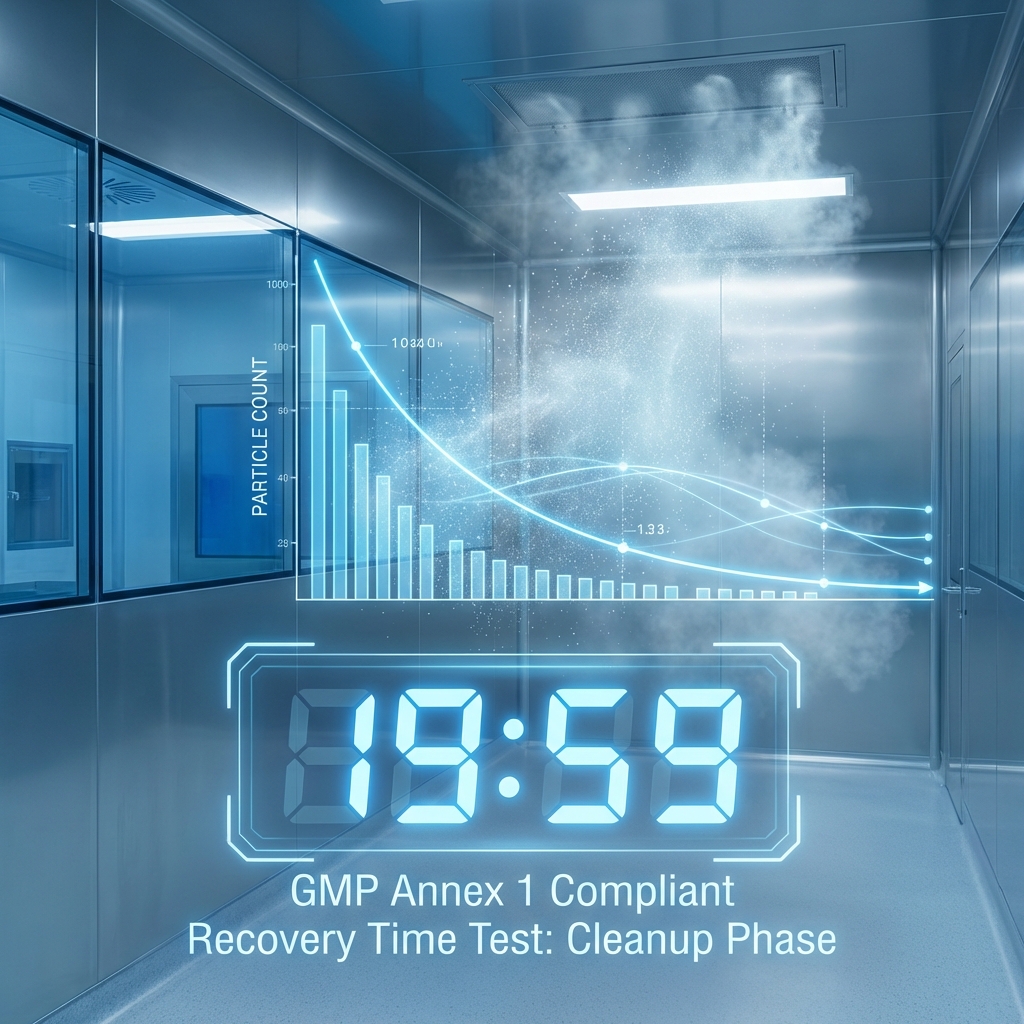
Compliance in Focus: An In-Depth Look at Cleanup Period and Recovery Time under EU GMP Annex 1.
In pharmaceutical manufacturing, a sterile environment is not a static state but a dynamic equilibrium that must be continuously monitored and protected. With the revised EU GMP Annex 1 coming into full effect in August 2023, the requirements for the Contamination Control Strategy (CCS) have been significantly tightened. A central aspect is the ability of a cleanroom system to return to a specified safe state as quickly as possible after exposure – whether through ongoing operations or a targeted technical disturbance. Here, two concepts meet that are often confused but pursue different regulatory goals: Recovery Time according to ISO 14644-3 and Cleanup Period according to Annex 1.
Understanding Recovery Time (ISO 14644-3)
Recovery Time, as defined in the international standard ISO 14644-3, is primarily a technical measure of the performance of the HVAC system. When determining the recovery time, the cleanroom is intentionally contaminated with a defined concentration of particles (usually by aerosol injection). Then, the time it takes for the filter system to reduce the particle concentration by a factor of 10 or 100, or to reach the original classification level, is measured. This test typically takes place during initial qualification or after major modifications. It states: "Is my system technically capable of removing massive air pollution within an acceptable time (often 15-20 minutes)?" It is thus a technical characterization of the air exchange rate and flow morphology under worst-case conditions.
New: Defining the Cleanup Period (Annex 1)
In contrast, the Cleanup Period has gained a new, process-oriented meaning in EU GMP Annex 1 (2022). It describes the period needed to reach the "at-rest" state after the end of activities (whether production or cleaning). Unlike recovery time, no artificial contamination is introduced here. Instead, the real particle load of the regular process is used as a basis. Annex 1 explicitly stipulates that the at-rest state must be reached after a defined cleanup period. This is not a pure technical test, but a validation of the operational procedure. It asks: "When is my room clean enough again after work so that the next batch can start safely?"
Key Regulatory Differences
The distinction is crucial: while Recovery Time proves that the technology works (qualification), the Cleanup Period ensures that the daily process is safe (routine monitoring/process validation). In practice, this means different triggering events: for Recovery Time, it is aerosol injection; for the Cleanup Period, it is the exit of personnel or the end of a cleaning process. Frequency also differs: Recovery Times are usually checked annually or biennially, while the Cleanup Period must be clearly determined for each room type and load scenario as part of process validation and verified regularly in monitoring. Failure to accurately document these differences risks critical deviations during audits.
Moqlero's Reaction to Annex 1
Moqlero has responded to these complex requirements by implementing a dedicated, automated cleanup measurement method. Our system offers a fully integrated digital solution - now including the cleanup period! First, Moqlero automatically and digitally determines the initial state using a mobile particle counter. After personnel leave, the measurement of the cleanup period starts automatically and is typically monitored every minute. After a maximum duration of 20 minutes or earlier achievement of the "at-rest" state, it is verified through three additional measurements. Of course, recording and logging take place in strict compliance with GxP requirements. The process has been successfully FDA-audited several times and has already established itself as a standard at leading global pharmaceutical companies.
In summary, Moqlero once again bridges the gap between the regulatory GMP world and the digital era of Cleanroom 4.0. By providing specific digital algorithms, we enable our customers to achieve seamless compliance and maximum process reliability.
Ensure seamless Annex 1 compliance – with automated clean-up tests from Moqlero.